sábado, 10 de marzo de 2012

Felix-Gaspar Tournachon Nadar


Felix Gaspar Tornachon Nadar ( 1820 – 1910 ):

French photographer, he was one of the first portraitist. Like Le Gray he was more interested in art than in making money, for that reason both of them had economic problems.

He refused to retouching the color in his portraits and also renounce to use props. The gesture and the light are the main elements.

He  made portraits of many celebrities of the time.


Sarah Bernhardt


Gustave Doré


George Sand


Eugene Delacroix


Alexander Dumas


Jules Verne


Auguste Rodin


Charles Baudelaire


Emile Zola


Selfportrait


He made the first aerial photographs in histoty.


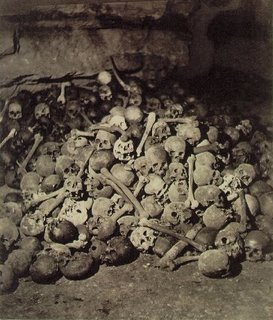
He was also the first to use artificial light, it was in the catacombs of Paris.


martes, 6 de marzo de 2012

Willian Henry Fox Talbot


Willian Henry Fox Talbot ( 1800 – 1877 )

English researcher,in parallel to Niépce and Daguerre, and with a huge scientific training, Henry Foz Talbot invented another way of taking pictures: The Calotype.

With this method he could obtained many copies of each negative. The images were less sharp and they lacked of the daguerreotype gray scales, but the calotype was cheaper, easier to use and it required a shorter time of exposure (only 30 seconds).

He published the first illustrated book of photos "The pencil of natura, 1844".


"The Ladder"


"The Haystack"


"The Broom"


"Ships at low tide"


lunes, 5 de marzo de 2012

Louis-Jacques Mandé Daguerre


Louis-Jacques Mandé Daguerre ( 1787 – 1851 ):

French researcher, he had invented the Diorama: Huge images that he could move, combined with lights and sounds, all together had  sense of dimension and sense of being inside the picture.

Because he needed very realistic images for his dioramas he became interested in the work of Niépce.

Finally he and Niépce ended  associated, when the second died Daguerre following the research and invented the Daguerreotype.


The first photography that shows a human "Boulevard du Temple,1839".


"The Louvre"

Besides the photography he also was a very good painter. Here some of his paintings: 


"Interior of Rosslyn Chapel"


"Ruins of Holyrood Chapel"

Joseph Nicéphore Niépce


Joseph Nicéphore Niépce ( 1765 – 1833 ):

He was a French researcher who obteined the first photographic images, the procedure used was called Heliography.

He made two different kind of images:

Heliogravures which were reproductios  of engravings of that time and Point of views, which were captured directty from natural images, both taken by the camera.


The first photography preserved "Point of view from the window of grass, 1827".


Heliogravure


Point of view


jueves, 1 de marzo de 2012

Focal length / Multiplication factor


Focal length and viewing angle


The focal length is a number in milimeters (mm) which indicates how many degrees the lens is able to cover.

Focal length and length of the lens are not the same.  Some shorter lenses have more focal length than other longer lenses. 

Table

Focal length            Viewing angle

15mm180 º
20mm94 º
28mm75 º
35mm63 º
50mm46 º
85mm28.5 º
135mm18 º
200mm12 º
300mm8.25 º
400mm6.16 º
600mm4.25 º

Graphic


Multiplication factor

The data on the lenses regarding the focal length are given for a sensor of 35 mm in size, but just some professional cameras have that size, the rest have smaller sensor size.

To know what focal length corresponds to our camera we need to know the mutiplication factor of that camera. The smaller the sensor size the greater the number of factor.

We have to see that number in the instructions for the camera and multiply that number by the focal length of our lenses. 

Examples

Canon 60D - factor 1.60x - lens 50mm

A lens with a focal length of 50mm on that camera corresponds to:

50 x 1.60 = 80mm

Canon
7D - factor 1x - lens 50mm

The lens does not change, a focal length of 50mm on that camera correspond to:

50 x 1 = 50mm.

Camera with a lens factor 1.50x - lens 70mm

70 x 1.50 = 105mm.

So if we put in that camera a 70mm lens it will be actually acting like a 105mm by the multiplier effect.


Extenders


With them we can increase the focal length of the lens. There are different values.


Lens

Types of lenses:

Macro


They are used to be able to photograph objects from very close. We can focus at a distance from 1 cm of the lens.


Fish eye


They have the greater viewing angle, they can reach 180º or more. Its focal length is usually between 6 and 16 mm.

They have many distortions in straight lines so the image appears whirring.


Wide angle


They have a viewing angle ranging from 180 º to 63 º. Its focal length is usually between 18 and 35 mm.

There are also distortions in the straight lines that can be more or less accentuated depending on the quality of the lens and the angle of view.

We can get images of great realism with much depth of field.


In these and in the fish eyes the more closer the more distorted the object will be.


Note of interest: 

Objects appear smaller in proportion to the width of the viewing angle, so that emphasize perspective.

We can make near objects appear larger simply putting the lens near them, while the most distant objects still would seem smaller.


Example: If we get a photo of a building from a corner and from the bottom it seems taller and longer that it really is.


Regular


They have a viewing angle very similar to human eye (45 º). Its focal length is 50 mm usually.

They are the most luminous and they haven´t any distortion.


Telephoto


They have a viewing angle of 30º or less and a focal length from 70 mm onwards.


They compress the levels and sometime they are unrealistic because the distances between objects are reduced considerably.


Note of interest: 

For portraits one of the features of this lens is the ability to make selective focus. We can show the sharp face on a blurry and out of focus background (bokeh effect), in this way we will put the attention on the face. For that we can use focal length from 70 to 135 mm. More distance would be for distant photos.


Example: Bokeh effect with all blurry unless the person.


Summary: 

From the same position lenses with wide angle can capture more space and the objects are smaller, while lenses with narrow angle can capture less space but the objects are bigger.

Wide angle lenses emphasize the perspective. Narrow angle lenses compress the space, things seem to be near each other that in reality are.

Narrow angle lenses are nice for portraits and wide angle lenses are nice for landscape.

Beware:

In portraits wide angle lenses make the nose bigger, narrow angle lenses make it smaller.
There are lenses that focus better in the middle, in this case we must avoid making compositions always around the center. One trick, we have to focus in the center and the use the AF-LOCK (focus lock). To learn about how to use the AF-LOCK the best way is to look the instructions of each camera.


Zoom lenses:

They are lenses that have different focal lengths.


They used to be of lower quality than fixed lenses but now the quality is quite similar.


IS / AF  lenses:

IS lenses:

The lenses with stabilizer (IS) can lower the risk of motion blur. We can use a slower shutter speed without tripod, this means higher image quality and more freedom of movement.

AF lenses:

These lenses have auto-focus. The lens focus automatically.
Not always be convenient tu use the AF, sometimes we get better results with manual focus (MF) because there are surfaces that are not easy  for the AF. In these situations we must to change from AF mode to MF mode (there is a button on the lens).

Beware:

The AF does not focus well on white surfaces, shiny and reflective objects, one trick is to focus around these surfaces, taking care that the distance between this new point is similar to the distance between the subject and the camera.


miércoles, 29 de febrero de 2012

First steps


To begin to master the photography there are 3 basic elements:


The Lens that I will use, its luminosity, viewing angle, focal length.


The amount and quality of the light.


The object that I want to photograph, its characteristics and the environment in which it is located.